Exploring diverse income streams
Overview
- Introduction
- Who is this information sheet for?
- What is income generation?
- Sustainable funding: across the income spectrum
- Gift Economy
- Grant funding
- Structured market
- Open market
- Current Fundraising Mix Tool (Excel spreadsheet)
- Why is it important to have a diverse income stream?
- Starting point
- The Income Generation Health Check
Introduction
This resource has been produced as part of the work of the Sustainable Funding Practitioner Network, WCVA and CVC Development Officers, working as part of Third Sector Support Wales partnership to support voluntary sector organisations. Collectively this partnership works on shared resources to deliver support to the voluntary sector across Wales.
This resource uses the Income Spectrum Tool, originally developed by NCVO, this offers a useful visual guide to the key forms of income that an organisation can explore.
Who is this resource for?
This page is aimed at small and medium organisations, including those which are volunteer led and focus on local or regional delivery with a smaller team. Larger organisations with paid staff and support from a national network or parent charity, may still find this a useful visual tool.
One challenge that groups commonly face is balancing current delivery with planning for the future. Taking time to review resources like this can help with achieve this balance. Funding availability is a key consideration in reaching future plans and goals.
Karen Chalk, Director of Circus Eruption says:
‘Income diversification is crucial, but it’s never a “quick fix”, and there are loads of things to think about. Our ‘trading’ journey is a good example of this. Eruption started to offer circus workshops to other groups and organisations in the early 2010s, when we had already been running for 20 years, but it wasn’t an “ad hoc” decision. It was developed out of a strategy and planned growth was slow, with attention to capacity. It’s generally provided around 1/3 to 1/4 of our total yearly income fairly consistently during a 10 year period where our revenue income/expenditure, staffing etc has tripled.
‘Across 2024, we had 10 full day sessions of “train the trainers” training in order to be able to deliver a new trading offer – inclusion/participation training – because we’re very experienced in this in practice, but hadn’t really worked on spreading the word before. We were hoping to be offering this already (early 2025) but need to do more work on marketing/HR before we launch a new “product”.
‘It’s crucial to make sure that any efforts for new sustainable income streams have a positive impact on your organisation and is never at the expense of your charitable objects. Overall sustainability should always be in pursuit of your objects, and any income generation has to fall in with that, both in theory and in practice. Taking time to think about impacts in this way and making as sure as you can that they will be positive, not just financially, is the key to organisational/financial sustainability.’
What is income generation?
Income generation is the act of making money for your organisation and happens in different ways. The Income Spectrum Tool can be useful for considering income generation and which further sources might be appropriate to explore.
Consider:
- What are your current sources of income as an organisation
- What are your current assets, consider people & skills as well as physical resources
- Potential opportunities to generate an income with these
All organisations need resources to further achieve and deliver their aims and objectives. Exploring options can offer new opportunities for growth.
What are the benefits?
Sustainable funding for an organisation is where a group explores and benefits from a mix of income options spreading reliance over a few different sources of income. Organisations with a mix of income strands are more robust in the event of external factors impacting on a funding source.
Benefits of a diverse income:
- Able to plan ahead
- Stronger organisation
- Less reliant on one source of income if that is withdrawn
- Some sources of income may fit well with your service delivery whilst also helping to spread the message/need for your service i.e. providing training courses in an area you specialise in
(The following information refers to the NCVO income spectrum tool)
Key features of the NCVO’s income spectrum tool
- Describes the main income streams available
- Defines the relationships associated with each source of income i.e. people or organisation
- Explain the expectation relating to what the organisation does for the income. A greater expectation/ input is required as you move from the left to the right of the spectrum
- Helps identify where funding comes from/could come from
Explanation of the sections
Used actively the Income Spectrum Tool can help identify actions for your organisation to take. Could you use this as part of a Board Meeting or as a facilitated development session?
You can use it to;
- Assess your current funding ‘mix’
- Identify current income streams and
- Begin reflecting on the features of the sources and suitability
- Assess whether a more diverse funding approach is needed
- Consider how reliant you might be on any source
Which income sources might be suitable for your group to explore?
Sustainable funding: across the income spectrum
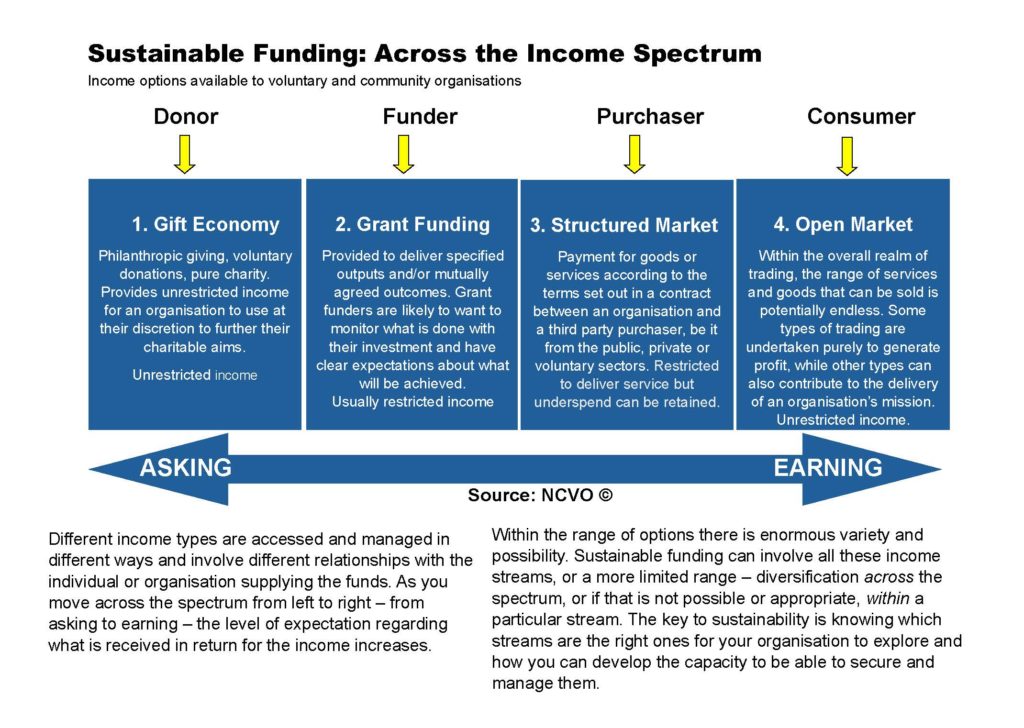
A PDF version of the infographic is available here.
From left to right on the Income Spectrum the following section explores the different funding sources.
Gift Economy
The Gift Economy is all about donor giving. Donors can be individual or corporate. It is generally unrestricted funding in general support of your work, meaning it can be used at the discretion of the organisation to further its general aims and activities. Unrestricted funding is very useful for organisations as it can cover costs which are less attractive to grant funders i.e. the day-to-day running including replacement of items necessary to deliver services which might be ineligible under grant applications. Also very useful for unexpected costs that crop up, for costs such as office equipment or running costs which can be more challenging to meet from other funding sources.
Gift economy sources include;
- income generated from philanthropic giving
- voluntary donations
- community fundraising
- individual donations
- corporate donations
Remember these are distinct from grants for something specific with an expectation of spend on a specific project to deliver outcomes in keeping with defined priorities. Usually a level of financial reporting and terms and conditions of spend.
Tips:
Consider whether you are giving opportunities for ‘gift economy’ giving such as one off donations, regular direct debit etc.
The relationship involved here is a donor and they have low/minimal expectations, with little expected in return as they are generally just keen to support what you do and your ethos as an organisation. You might consider how you keep them informed about the positive work of your organisation to ensure they remain engaged and that you retain their support.
Grant funding
Grant funding is usually allocated through a formal application process where a group demonstrates that they meet specific and defined priorities of the funding source and requests a specific amount of funding to achieve this. Funding is given for defined costs to deliver specific outputs/outcomes as set out in the approved application. This funding is usually restricted, which means that it is given to be spent very specifically on the costs and activities as set out in the application it was allocated for, aligned with a funders priorities.
The relationship involved is with a funder, they are likely to want to monitor what is being done with funds invested. There is a clear expectation about what will be achieved with the funding.
Grant sources include:
Statutory grants, Lottery grants, trusts and foundations, corporate grants, community foundations
Tips:
Funding Wales – register here to find out more about possible grants available.
360Giving – 360Giving (threesixtygiving.org) a useful resource to see giving trends and grant givers information
Grants are often most suited to;
- pilot projects
- development of a new service/angle of service
- bringing about a step change in the way you do something
- a clearly identified item or time-bound project
Grant funders are likely to want monitoring returns to show what this investment has contributed to, may have publicity requirements and clear expectations around a report on what was achieved.

Structured market
Funding through the structured market involves the payment for goods or services delivered under the terms of a contract or service level agreement between an organisation and a third-party purchaser. The party is commonly from the public sector.
The Structured Market includes:
- Delivery of your core services i.e. counselling support
- Contracts to deliver with public sector partners i.e. local authority/health board
Tips
To maximise potential opportunities of funding through this avenue get to know different partners contracting cycles and the platforms used to publicise contract specifications
Courses from agencies
Such as ‘How to Tender’ with Business Wales and their team of Tendering Advisors
The Sell2Wales website is a Welsh Government procurement portal advertising opportunities worth billions of pounds in contracts for public sector goods and services.
etenderwales: e-tendering portal for Value Wales
E-tender Wales is where you apply for these opportunities. ETenderWales Bravo Solutions site enables you to submit online tendering opportunities in a secure environment (please note this is not your Sell2Wales logon).
The relationship involved is with the purchaser/commissioner of that service and the contract to provide this service is legally binding. One thing included in this contract is the amount of income that will be provided for that service. As contracts are legally binding, the supplier is bound by the contract to deliver specific targets, within specific timescales and to a specific budget. This is a restricted income i.e. given to deliver the contract with a number of related expectations including specific targets, to a specific timescale and budget.
Open market
Generating funding through the open market is about trading activity and involves the sale of goods or services to earn an income. This is an increasing area of growth and awareness in the third sector where there is a lot of potential. It may require a change in mind-set from offering things for free but may involve exploring new markets such as delivering a paid-for service alongside those offered for low or no cost. Trading activity can sometimes also be known as social enterprise – an enterprise with a sound business model and community benefit.
One of the real positives about generating an income on the open market is that this is unrestricted income. Trading can also help develop new approaches and enhance the skills of an organisation.
If trading is something you wish to explore then you would need to determine the following:
- The trading category your activity fits into i.e. primary purpose, ancillary or non-primary
- Whether it can be delivered by the charity itself or requires a subsidiary trading company
- The tax position relating to charities trading
- When to set up a subsidiary trading company
Consider whether you need the following and get them in place:
- Bank account if setting up a separate organisation
- Skills on the board, different skillset possibly with a different board or to broaden the existing one
- Skills audit of staff to see what they have to offer/trade
Some questions to ask when considering Open Market income opportunities:
- Can you sell your skills, possibly packaged in a different way to your core service / to a different audience?
- Can you offer a paid for version of any free or subsidised services?
- Can you offer something of value/ use to a different audience?
- Can you use your assets in a more efficient way?
- Can you charge for delivery of your core services i.e. counselling support?
- What are the costs involved in developing the product/ service, helps manage any financial risk?
Tips: A skills and assets audit can be a useful way to explore opportunities for income from the open market
Examples include: Charity shops: trading arm, Online shop, a shopping service, specialist training, merchandise
Trading generates unrestricted income for an organisation.
There are different types of trading, some to purely generate a profit (unrelated trading) and others involving trading as a part of the delivery of the aims and objections (mission-related or core trading) as well as social firms creating inclusive jobs and training opportunities for those requiring a more supported work environment.
When an income is generated on the open market the people we engage with are consumers, making a choice to purchase the goods or services. Consumers have expectations when they buy on the open market to receive a certain standard of product or service delivery in return for the money which changes hands. A sense of buying into the aims of what the organisation does adds additional value whilst it remains important that wider competition is considered alongside quality to foster consumer loyalty. This can help with ensuring sustainability of this income source.
Further reading
CVC and CWMPAS: Social Business Wales (ensuring requirements are met).
Good Finance
Social Business Wales
https://businesswales.gov.wales/socialbusinesswales/
https://businesswales.gov.wales/socialbusinesswales/other-sources-support-social-businesses
https://businesswales.gov.wales/socialbusinesswales/sources-finance
https://businesswales.gov.wales/socialbusinesswales/financing-social-business
Current Fundraising Mix Tool (Excel spreadsheet)
This Tool offers a useful way of assessing whether your organisation has a diverse income, indicating which areas your organisation is currently reliant on.
The tool can be used as a starting point for developing a strategy, identifying quick wins, or as evidence for conversations with your charity’s Board of Trustees.
Instructions for use:
You can use current year projections or your accounts from a previous year (the information will be in the profit/loss page. All the information you require is in the Profit column). You can also use your Management Account to find the relevant information for the following Rows.
From your financial information, find the value of the following income sources for your organisation, then input value (£) into the relevant column:
DONATIONS
1. Individuals (individual giving, events and sponsorships, legacies, major donor)
2. Private sector/Corporate
GRANTS
1. Trusts and Foundation
2. Public sector agencies
3. Private sector
CONRACTS
1. Voluntary organisations
2. Public sector
3. Private sector
TRADING
1. Individuals
2. Voluntary
3. Public sector
4. Private sector
Following values being input, you can use this information to complete SWOT (Strengths, Weaknesses, Opportunities, Threats) for your organisation. Please refer to Sample Worksheet for an example.
Why is it important to have a diverse income stream?
Charities, community groups and community interest companies of all shapes and sizes have summed up some of their concerns about relying on one source of income (usually grant funding).
Diversifying: what might it mean in terms of funding sources?
‘Even our multi-year unrestricted funding comes to an end. We can’t rely on that.’
‘Our main funder won’t fund more than 25% of our total income. By having money coming in from different sources we can mitigate the risk.’
‘Nearly all of our funding applications are now asking about the project/organisation’s sustainability when the funding comes to an end. It’s clear we need sources of income from different pots to help explain how we can continue this work, rather than just saying we’ll apply for more funding’
‘We just needed £5k, it was just easier and quicker to apply for a grant for that. But thinking about it, if we had raised funds in different ways, it would have been there for us to use and caused less stress for the organisation.’
‘We need help justifying to our Board that investing in fundraising from other sources will work. But all of the research I’ve seen shows a return on investment of between £7 and £20 per £1 spent on fundraising. And most of this income seems to be unrestricted.’
Starting point
All organisations are different, and your income will likely come from a range of sources. It is worth taking the time to calculate the percentage of your total income for the year that you have received from these sources. Current Fundraising Mix Tool is a tool for seeing at a glance what your organisation is most reliant on. It helps you to carry out a quick SWOT analysis on the four income generation areas of donations, grants, contracts and trading. A sample of the activity has been done for you.
The Income Generation Health Check
A health check, also referred to as a strength checker, review, or audit is a self-assessment exercise with a list of questions to address, to ensure you are in the best position to be able to generate income. There are a number of things that you should have in place to make the process of generating income, through any avenue, easier and more efficient. Completing a health check and addressing any gaps you identify through it will help make your income generation activities as smooth as possible and help your organisation to make best use of their income generation capacity.
Health checks also help to identify areas for development by highlighting weaknesses and opportunities. Actions on these areas can be developed into a plan to be worked on over a period of time that works for you and in a way that is appropriate for your organisation.

Income Generation Health Check
This resource explains how to undertake an income generation health check. By performing this health check, you can ensure you have the right policies, procedures and tools in place to strengthen your organisation’s income generating capabilities and improve your chances of bringing additional income into your organisation.