Working with the chief officer
The UK Charity Governance Code states that ‘The board provides oversight and direction to the charity. It supports and provides constructive challenge to the organisation, its staff and, in particular, the most senior member of staff’.
This information sheet provides guidance for trustees and board members on creating a constructive working relationship with their Chief Officer, and other senior members of staff, to ensure that the organisation can thrive.
Overview
- Introduction
- Governance v. management
- Management structure
- Delegation
- The role of the chief officer
- Relationship between the board and the chief officer
- Supervising and supporting the chief
- Further information
- Disclaimer
Introduction
The management structure of voluntary organisations can vary greatly and the formality of this structure is often determined by size and resources.
But even in the simplest of organisations there will be a board, or committee of people who take overall legal and financial responsibility for the organisation as a whole. This role is known as ‘governance’.
Depending on the legal structure of the organisation, this group of people may be known by a variety of names such as: the management committee, board, trustees etc, but whatever they are called, they have overall responsibility for running the organisation in accordance with their governing document, the general law and best management practice.
For more information on the Governance role see Principles of governance
Governance v. management
First, it’s important to differentiate between the concepts of ‘governance’ and ‘management’, so as to understand the relationship between the board and senior staff:
- Governance is the term used for the matters which trustees must deal with themselves , as opposed to those that they can delegate to staff and others. It is about controlling the organisation and includes setting the strategy, promoting the objects and safeguarding the assets
- Management is the day-to-day management of the organisation and operational matters that do not need to be handled directly by the trustees, and can therefore be delegated to staff. It is about running the organisation in a more ‘hands on’ sense, and includes managing staff, delivery of services and general administration.
Trustees remain ultimately accountable for the charity under the Charity Commission’s CC3 guidance: The essential trustee CC3
Management structure

The working relationship between trustees and a Chief Officer functions best when roles are clearly defined. Trustees are responsible for setting the charity’s strategic direction and ensuring good governance, while the Chief Officer is typically tasked with implementing strategy and overseeing day-to-day operations.
In some organisations, the Chief Officer may also carry the title of Chief Executive, Director or Manager. Regardless of title, the role serves as a bridge between the board and staff, translating strategic decisions into operational activity.
Where staff teams are small or part-time, the Chief Officer may also undertake direct service delivery or fundraising responsibilities. Trustees should remain mindful of these operational pressures when agreeing performance expectations.
To support clarity, organisations are encouraged to develop a Scheme of Delegation (see following section), which helps formalise which responsibilities are retained by the board and which are delegated to the Chief Officer or staff.
In organisations where there is a division of governance and management responsibility, the relationship between the board and the Chief Officer is crucial to the success of the organisation. It is helpful to picture this relationship as follows:
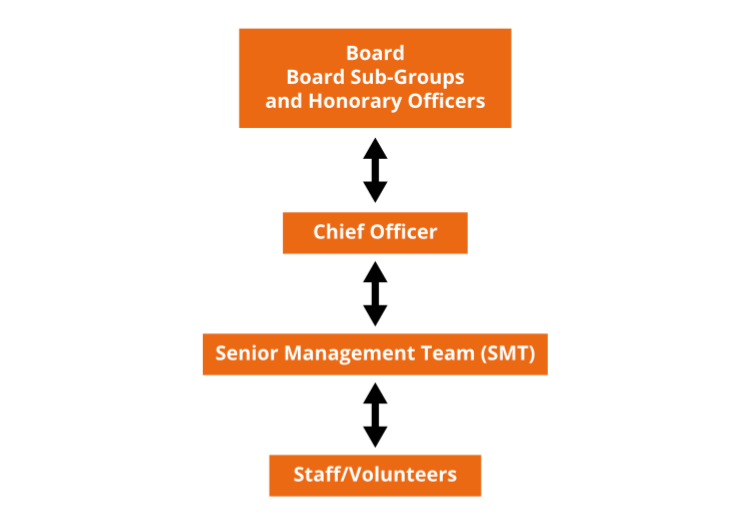
The role of the Chief Officer is therefore pivotal, and it is essential that the relationship between the board on the one hand, and staff etc on the other, is clearly defined. If it is not, the process of delegation and the ultimate effectiveness of the organisation can be undermined.
Delegation
Responsibility for, and authority over, the organisation rests with the board. Whilst ultimate responsibility cannot be delegated, certain functions can be. In larger organisations where there is a separate Chief Officer or manager, day-to-day matters have to be delegated to staff so that they can act on the board’s behalf in running various aspects of the organisation.
Due to complex legal reasons, the board requires an explicit power to delegate some of its functions and this is usually found in an organisation’s governing document (although it can also be granted by Statute or by the membership in some cases). Because the board remains responsible for all of its delegated functions it follows that the process of delegation should be strictly controlled, so that the board can be sure that those functions are being discharged properly within the terms of the governing document, the general law and best practice. This can only be achieved if the process is formalised.
In order to achieve effective delegation the board should ensure that:
- A policy is drawn up setting out the board’s powers and parameters of delegation
- The terms of each delegated function is set out in writing, including relevant monitoring, supervision and reporting requirements
- Job descriptions clearly set out all delegated functions included in each role
- The relevant staff members have the requisite skills and support to carry out the delegated functions, and receive training where necessary.
ICSA Guidance: Matters reserved for the board of trustees
The role of the chief officer
The role of the Chief Officer is crucial as they will be largely responsible for managing the organisation on behalf of the trustees.
The Chief Officer is responsible for implementing the organisation’s safeguarding policies, and escalating any serious incidents to the board or regulators, as required.
As the UK Charity Governance Code states, ‘The board, through its relationship with the senior member of staff, creates the conditions in which the charity’s staff are confident and enabled to provide the information, advice and feedback necessary to the board.’
The responsibilities of the Chief Officer usually include:
- Implementing and overseeing the day-to-day management of the organisation
- Implementing the organisation’s safeguarding policies, and escalating any serious incidents to the board or regulators, as required.
- Delivering the work of the organisation against objectives that are set by the board
- Making decisions where authority has been delegated by the board
- Acting as the interface between the board and staff
- Representing the organisation externally on behalf of the board
- Reporting regularly on progress and achievements to the board informing and advising the board so that it is able to carry out its governance role
- Providing information on operational issues, problems and policy matters, and makes recommendations for the board to consider
- Drawing up proposals for the future strategic development of the organisation’s work for the board to consider.
- The Chief Officer is responsible for implementing the organisation’s safeguarding policies, and escalating any serious incidents to the board or regulators, as required.
The scheme of delegation
To support clarity in decision making, many organisations choose to adopt a Scheme of Delegation. This is a written document that sets out which responsibilities and decisions are retained by the board and which are delegated to the Chief Officer and other staff.
A clear Scheme of Delegation:
- Promotes accountability
- Prevents misunderstandings
- Ensures appropriate oversight
For example, the board may retain responsibility for approving the budget, while the Chief Officer may be delegated authority to approve expenditure within that budget up to an agreed threshold.
Organisations may also wish to consider creating a simple template that outlines common areas of delegation, such as HR decisions, communications, and financial controls, with sign-off levels clearly set out.
Relationship between the board and the chief officer

The Chief Officer needs a clear framework within which they can get on with directing the work of the organisation and use their professional judgement and skills.
The separation between governance and management should be maintained, ensuring that the Chief Officer is not hampered or impeded by the interference of the board in the day-to-day running of the organisation.
To make the relationship effective, board members should have:
- A vision for the organisation which is shared by the Chief Officer
- A commitment to achieving the objectives of the organisation within the existing governance and management structure
- Well understood roles so that they do not conflict with the role of the Chief Officer, or interfere with the day-to-day running of the organisation.
- Confidence in the ability of the Chief Officer and a willingness to support their legitimate decisions (e.g. disciplining of staff)
- A willingness to maintain a two-way dialogue with the Chief Officer and share information that is relevant to the discharge of their delegated functions
- A realisation that the board should act collectively, and generally communicate with the Chief Officer in a structured way (except in emergencies), preferably through the Chair
- A willingness to strike a balance between the planned predetermined priorities of the board , and the operational flexibility required by the Chief Officer to react swiftly to changing circumstances and to capitalise on opportunities
- A formal process by which the performance of the Chief Officer can be appraised, and a mechanism by which they in turn can feed back to the board
The relationship between the Chair and the Chief Officer is particularly important because they will have to work together closely and the Chair is likely to have responsibility for supervising the Chief Officer. A breakdown in this relationship will cause significant problems for the organisation and could lead to either the Chair or the Chief Officer leaving. In order to work well together, it’s important that the Chair and Chief Officer:
- Establish trust
- Have a clear understanding of (and respect for) each other’s roles
- Have a shared vision for the organisation
It is also important that the board recognise that the personality of the Chief Officer can have a bearing on the emphasis and content of reported information.
For example, the Chief Officer may tend to:
- Only give good news, underplaying any problems and putting a very positive spin on everything
- Be cautious and tend to concentrate on problems, risks and bad news, so that they always present the worst case scenario, or
- Always give a very balanced and honest view of the current situation and what lies ahead.
By understanding this, the board can better interpret the information that they receive and put in checks and balances to ensure that they get a realistic picture of how the organisation is performing.
Equally, the personality of the Chief Officer’s main point of contact – usually the Chair – can have a similar bearing. In addition to this form of communication there should be a regular programme of meetings with the whole board, to ensure that their decisions and requests are accurately conveyed to the Chief Officer.
It is important that board members distinguish between their voluntary governance role as a member of the board and any other volunteering work they may do for the organisation, such as fundraising and even the delivery of the organisation’s service. The latter will be managed by the Chief Officer or another member of staff, and in this capacity the board member’s role is to be directed and not to direct.
In order to avoid tension and conflict, the board and the Chief Officer should respect each other’s roles and maintain clear boundaries. For example, trustees should not make unexpected visits to sites and question staff without the Chief Officer’s knowledge, nor should they contact staff individually to ask for information outside of what is required at board meetings. No matter how well-intentioned, these behaviours are likely to cause stress to staff and be experienced as undermining by the Chief Officer.
Supervising and supporting the chief officer

According to the Charity Governance Code, the board should make sure that there are proper arrangements for the appointment, supervision, support, appraisal, remuneration and, if necessary, dismissal of the Chief Officer.
It is the Chair that most often supervises the Chief Officer, but another board member may do so instead, or as well, if they have specialist skills in this area. If using a group, numbers must be kept to a minimum (possibly a specialist staffing sub-committee), but this can prove problematic in that it may inhibit the Chief Officer’s ability to be open about any concerns over the functioning of the board or individual members.
Supervision has 4 key elements:
- Setting standards for performance – including setting objectives and deadlines
- Monitoring and evaluating performance – including assessing progress against targets and reviewing work
- Feedback – including listening to concerns and solving problems
- Development – including addressing training needs and career development. The first two are concerned with measuring performance, while the second two are structured to provide support for the Chief Officer. They can cause conflict with each other, but this can be minimised by separating the two functions within the supervision session.
It’s important to remember that being the Chief Officer of a voluntary organisation is very fulfilling but can, at times, be stressful, so the board should make sure there are systems in place to support the Chief Officer, including where appropriate, with their mental health and well-being.
Related Guidance
Warning signs and problems with the chief officer’s performance
Whilst it is important that boards do their best to support their senior member of staff, unfortunately, some appointments do not work out well and there can be issues with performance. In these cases, the board should take steps quickly to try and address the issues and identify whether further steps are required. Here are some warning signs that there may be problems with the appointment:
- Board consistently not receiving the information they have requested, or finding out that the information provided was incorrect
- Agreed objectives consistently not being met without clear reason
- Multiple complaints and grievances about the Chief Officer from staff or volunteers, or an unexplained high staff turnover
- Concerns raised by funders or partners about the Chief Officer’s performance or behaviour
These issues should initially be addressed through the organisation’s supervision and appraisal systems, but if the board decides that disciplinary action, or dismissal, may be necessary, we recommend seeking legal advice from a qualified professional.
Where unresolved concerns persist, the board may seek external mediation, use HR consultants, or follow internal grievance and capability procedures before moving to formal dismissal.
Other senior members of staff
In a larger charity, there is likely to be a senior management team (SMT) in place who are responsible for key aspects of the organisation and work with the Chief Officer. One of the most important members of staff will be the Finance Director who will be responsible for providing information to the board about the organisation’s financial position and will have to work closely with the treasurer and the external auditors.
Other members of staff who will have regular contact with the board are Directors and Assistant Directors within the organisation. They may present to the board on areas of their work and be involved in various working groups and sub-committees. If the organisation has an SMT it’s important to foster a good working relationship between the board and the whole senior team, but without undermining the Chief Officer. Ways to achieve this could be through organising board and staff away days and a robust induction process for new board members which includes structured meetings with senior staff.
Further information
Charity Governance Code – Principle 2 ‘Leadership’ Charity Governance Code
https://www.charitygovernancecode.org/en
Faith and hope don’t run charities (trustees do)
Wales Council of Voluntary Action
https://wcva.cymru/wp-content/uploads/2020/01/WCVA-Faith-and-Hope-Dont-Run-Charities.pdf
Charity Commission for England and Wales
Charity Commission
https://www.gov.uk/government/organisations/charity-commission
ICSA: The Governance Institute
ICSA
www.icsa.org.uk
Recruiting a Chief Executive, Chair and Trustees
ACEVO
https://acevocommunity.force.com/s/store#/store/browse/detail/ a303z000000FknvAAC
The Association of Chairs
Association of Chairs
https://www.associationofchairs.org.uk/
Disclaimer

Third Sector Support Wales is a network of support organisations for the whole of the third sector in Wales.
It consists of the 19 local and regional support bodies across Wales, the County Voluntary Councils (CVCs) and the national support body, Wales Council for Voluntary Action (WCVA).
For further information contact
https://thirdsectorsupport.wales/contact/
The information provided in this sheet is intended for guidance only. It is not a substitute for professional advice and we cannot accept any responsibility for loss occasioned as a result of any person acting or refraining from acting upon it.