Learning and development
If you employ staff in your organisation, this information sheet will give you guidance on how to support their learning and development.
Overview
- Introduction
- Why invest in learning development?
- What is learning and development?
- The training cycle
- Disclaimer
Introduction

Many organisations recognise the importance of up-skilling their staff to deliver high quality services. Voluntary sector organisations play a vital role in society.
Their staff, managers, trustees and volunteers are crucial to their success. Therefore, it’s paramount they have the right skills, knowledge, confidence and approach to achieve the organisation’s goals.
All organisations, regardless of size or funding, benefit from structured learning and development. For charities without HR functions, responsibility often lies with the board or chief officer.
Getting started: A practical approach
Learning and development doesn’t have to be complex or expensive. The key is to make a start by identifying a few priorities and building on them gradually.
Here’s a quick way to get going:
- Start small: Choose 1–2 skills or knowledge areas each staff member or volunteer could benefit from.
- Use what you have: Peer learning, mentoring, webinars, and shadowing can all be valuable.
- Keep track: A simple spreadsheet or shared document can be used to record development goals and activity.
- Make time: Even 30 minutes per month dedicated to development can make a big difference.
- Review regularly: Build learning reviews into supervision, team meetings or appraisals.
This guide includes more structured options, but even informal learning can have a big impact when it’s planned and recorded.
Why invest in learning and development?
Voluntary does not mean amateur! Organisations provide vital services and it is essential they invest in their staffs’ skills, knowledge and abilities to carry out their work.
Definition
There are several benefits from investing in learning and development including:
- Increased morale and motivation
- Staff feeling valued and greater sense of belonging
- Better services
- Better staff retention
- Greater individual confidence and resilience
- Better communication skills and team working
- Increased innovation and efficiency
- Greater ability to adapt to change and meet the future needs of the organisation and its beneficiaries
- Competitive edge by developing services and having talented staff teams
What is learning and development?
Training – learning – development – mentoring?
What do you call it?
It’s worth noting the difference between training and development. Generally, training refers to filling skills gaps, often in technical areas. Training offers ‘quick fixes’ to help know-how such as:
- How to take minutes at meetings
- How to facilitate a Zoom meeting
- How to write a budget
These identifiable skills gaps can often be filled with appropriate face to face and online training. Competence is a combination of knowledge, skills and behaviour.
Development includes the enhancement of knowledge and behaviour, as well as skills. For many jobs it’s not just what you do that matters but how you do it. Changes in behaviour can take time and, therefore, investment.
Mentoring is a form of learning intervention where the learner is supported by a mentor who encourages and steers then to meet their mentoring goals.
Learning is what comes from all the above. When we invest in learning and development it’s important to make the connection between the learning and its relevance in the workplace.
Effective training and development enable the learner to make that transition from the classroom back to the workplace, so they can apply their newly acquired knowledge, skills, confidence and behaviours.
The training cycle
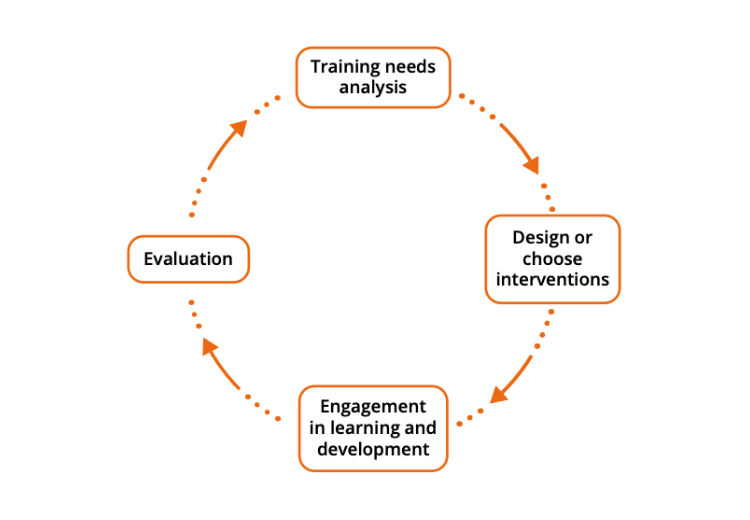
The Training Cycle above sets out the processes involved in managing learning and development. Stage one is where we identify training needs, then in Stage two we design, choose or commission appropriate interventions to meet the needs. In Stage three, staff participate in the learning and development activities and Stage four we review and evaluate.
Below you will find further information on each Stage of the training cycle.
Stage one – identifying training needs
Training and development offer an opportunity to equip staff with the capability and capacity to meet the challenges faced by the organisation, to deliver great services and to take on new opportunities. It is recommended that each organisation have a training plan that helps them meet their business goals. To plan our training, we must first work out what the training need is.
Training needs come from many sources: the changing external world, the culture and type of organisation, the job role and gaps in knowledge, skills and confidence of each individual staff member.
External world
Training needs are influenced by changes in the external world. External changes could include:
- How society is changing
- How the sector is developing
- Relationships within the sector
- Upcoming changes in law or policy
- Technological developments
- Environmental challenges or opportunities
- Changes to funding and finance
- Commissioners’ plans
- Areas of growth, slow down or change
Organisational changes
As organisations develop, they need to ensure staff have the capabilities to meet changing needs. These needs might come from:
- Changing strategic goals
- Responses to external challenges or opportunities facing the organisation
- Changing needs of their beneficiaries
- New beneficiaries
- Unmet beneficiaries’ needs
- Business developments in the short/medium/long term
- New areas of work
- New forms of working including remote working and blended work
- Mergers or structural change
Staff training needs
We know external and organisational changes influence training needs. Consider training needs arising from the staff themselves and their work.
- What are our performance expectations?
Look at the gap between current performance and future needs.
- Do staff need different skills or a different approach?
- Do we need to target the learning and development to certain staff, job roles or teams?
By assessing training and development needs we can purposefully build training and learning solutions that have a measurable impact.
Stage two – designing or choose interventions
To make sure your learning and development has real value, before signing up, learners will want to know how the training will benefit them and whether it will meet their expectations.
Staff will be motivated to engage and participate if they know the learning will help them in their current role or enable them to prepare for future roles. An effective training plan will connect each learner to the learning programme.
There are many ways in which we can meet development needs; here is a short menu:
- Online workshops
- Webinars
- In-house training courses
- Formal education through community learning providers, colleges and universities
- Volunteering
- Professional qualifications
- Self-directed research
- Coaching and mentoring
- Taking on a new project
- Secondments
- Shadowing someone else
Most effective learning and development plans will include a combination of these interventions.
Stage three – engagement in learning and development
Learning styles
The Kolb Learning Cycle suggests that to have the greatest effect we learn by working our way through the learning cycle, from Reflection on an experience all the way back to Experience.
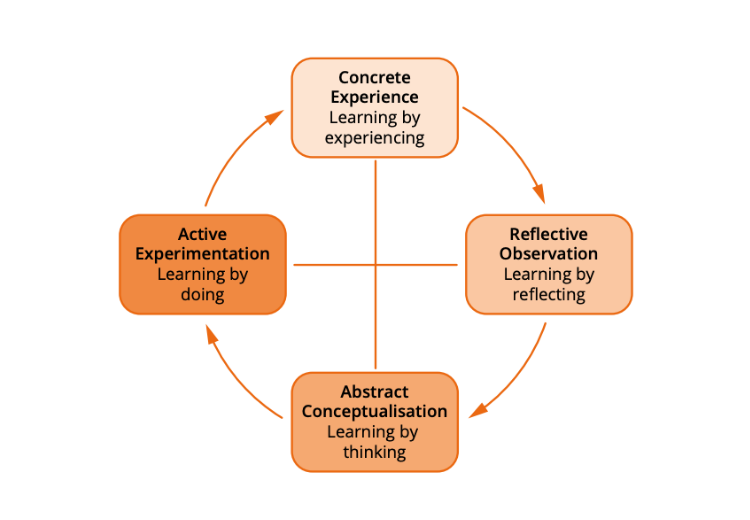
Peter Honey built on Kolb’s Learning Cycle and identified four preferred learning styles:
- Activist
- Reflector
- Theorist
- Pragmatist
As individuals we all have different preferred learning styles. Levels of staff engagement with learning can be influenced by their preferred style. Some interventions suit people better than others. The diagram below shows how the learning styles work in practice.
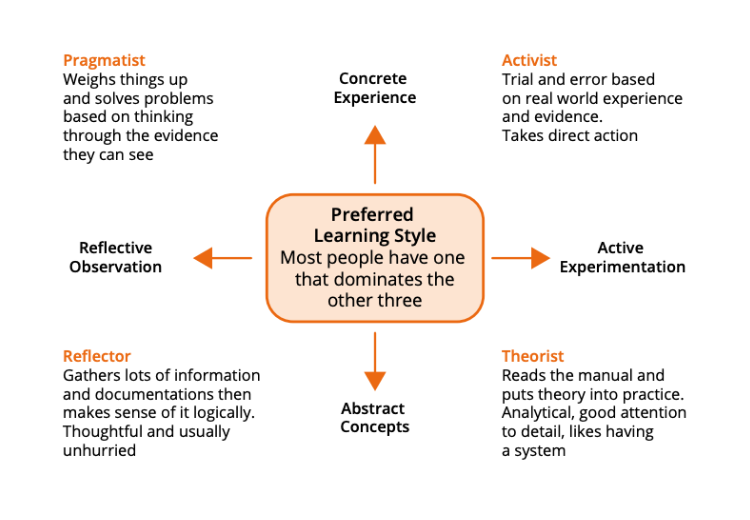
Activists
Activists involve themselves fully in new experiences. They are open- minded and enthusiastic about anything new.
They will try anything once and tend to act first, considering the consequences afterwards.
Activists like activity and thrive on challenge of new experiences and they like involving themselves with other people. They can get bored with implementation.
Theorists
Theorists think problems through in a step by step, logical way. They like to analyse and synthesise.
Theorists focus on assumptions, principles, theories, models and systems and their philosophy is ‘rationality and logic’.
Theorists tend to ask lots of questions and they tend to not like subjectivity or ambiguity. They often feel uncomfortable with subjective judgements and lateral thinking.
Reflectors
Reflectors like to stand back and think about experiences; they are thoughtful people. They like to observe from many different angles and perspectives.
Reflectors collect data, both first hand and from others and prefer to think through information thoroughly before concluding.
Reflectors tend to postpone reaching definitive conclusions for as long as possible; their philosophy is ‘caution’.
They enjoy observing other people in action. Reflectors often take a back seat in meetings and discussions and will listen to others before making their own points.
Pragmatists
Pragmatists are keen on searching for and trying out new ideas, theories and techniques to see if they work
in practice. They tend to return from learning brimming with new ideas to try out in practice.
Pragmatists tend to act quickly and confidently when ideas attract them. They tend to want to get on with things and can be impatient with long-winded and open-ended discussions.
They are practical, down to earth people who like making practical decisions and solving problems. Pragmatists see problems and opportunities ‘as a challenge’. Their philosophy is ’there is always a better way’ and ‘if it works its good.’
It’s worth understanding people’s learning styles to be able to match them well with learning interventions. We are all likely to have a mix of preferred styles, but our preference can influence how well we engage with different forms of learning and development. For more on this see Peter Honey’s website.
You can purchase the questionnaire from Talent Lens: TalentLens Honey and Mumford Questionnaire
Accreditation or not accreditation?
When you plan your learning and development its worth considering if you want your staff to follow accredited programmes.
For small teams or those in rural areas, non-accredited training can still offer valuable professional growth if tailored to job roles.
So, what is accreditation?
Accreditation is the process by which a learning programme is assessed and ‘badged’ by a learning provider to confirm it meets high quality standards of delivery and that it addresses specific learning objectives. Learners who follow an accredited programme usually submit assignments that are assessed against the learning outcomes. If they meet the requirements of the programme, they will receive their accreditation in the form of a certificate, confirming their learning.
In the Voluntary sector the most used accreditation for training are Agored Cymru and ILM. WCVA provides both accredited and non-accredited programmes.
For accredited and non-accredited training options, see: WCVA CYMRU Training
There are advantages and disadvantages to both accredited and non- accredited programmes.
Accredited programmes
| Advantages | Disadvantages |
| Has a mark of high quality and consistency | Can be costly to deliver and assess |
| There is consistency in design and delivery of each programme, against a set of externally recognised standards | Tend to be longer programmes, requiring greater commitment of time from the learner |
| By successfully completing the programme learners receive certification for their achievement | Can put off less confident learners |
| Administrative burden | |
| Can be short programmes, focusing on specific learning outcomes | No external recognition of achievement |
| Can be customised better to the needs of specific groups of staff | Looks less impressive on people’s CV for the future |
| Less costly to deliver | |
| No assessment |
Continuing professional development (CPD)
Finally, in Stage three remember to consider how you will maintain records of achievement. In larger organisations with an HR department, staff may have an online record of achievement or record of their CPD.
Even in small teams, keeping a basic training log or CPD tracker can help evidence skills growth and funding compliance.
Organisations of any size can do the same. It is a good idea to have a system so staff maintain a record of their own learning and development. This helps them prepare for annual appraisal and it’s a way of the organisation and staff having a mutual understanding of their development and growth in the role. A simple online system is the best approach.
Stage Four – Evaluation
We can evaluate learning and development from many perspectives: the learner’s, the employer’s, the learning provider’s and in some instances, the funder’s, particularly when the funding comes from an external source such as a grant-giver.
The New World Kirkpatrick Model outlines 4 levels of evaluating training.
Level 1: Reaction
The degree to which learners find the training favourable, engaging and relevant to their jobs. This includes an assessment of:
- Participant satisfaction – what they thought of the programme
- Level of engagement – how participants are actively involved in and contributing to the learning experience
- Relevance – the degree to which participants have opportunities to apply what they learned on the job
Level 2: Learning
The degree to which learners find the training favourable, engaging and relevant to their jobs. This includes an assessment of:
- Knowledge – “I know it.”
- Skill – “I can do it right now.”
- Attitude – “I believe this will be worthwhile to do on the job.”
- Confidence – “I think I can do it on the job.”
- Commitment – “I intend to do it on the job.”
This level looks at the outcomes from the training for the learner.
Level 3: Behaviour
The degree to which participants apply what they learned during training when they are back on the job. At this level, the manager is expected to engage with the learner to ensure they are enabled to apply the learning back in the workplace.
Level 4: Results
When we evaluate a programme from the employer’s perspective, we want to measure Return on Investment or ROI. This includes:
- Measurable impact on overall performance
- Measurable impact on business goals
Level 4 looks at the degree to which outcomes occur because of the training, and that critical behaviours are on track to create a positive impact on desired business results. This level enables us to assess how much impact the learning has on the organisation and its services and projects.
To evaluate outcomes (i.e. changes in skills, knowledge, behaviours and confidence) at levels 2, 3 and 4 there needs to be a baseline assessment of where the learner is before the programme starts – e.g. their level of knowledge, skills, confidence, etc.
Disclaimer

Third Sector Support Wales is a network of support organisations for the whole of the third sector in Wales.
It consists of the 19 local and regional support bodies across Wales, the County Voluntary Councils (CVCs) and the national support body, Wales Council for Voluntary Action (WCVA).
For further information contact
https://thirdsectorsupport.wales/contact/
The information provided in this sheet is intended for guidance only. It is not a substitute for professional advice and we cannot accept any responsibility for loss occasioned as a result of any person acting or refraining from acting upon it.